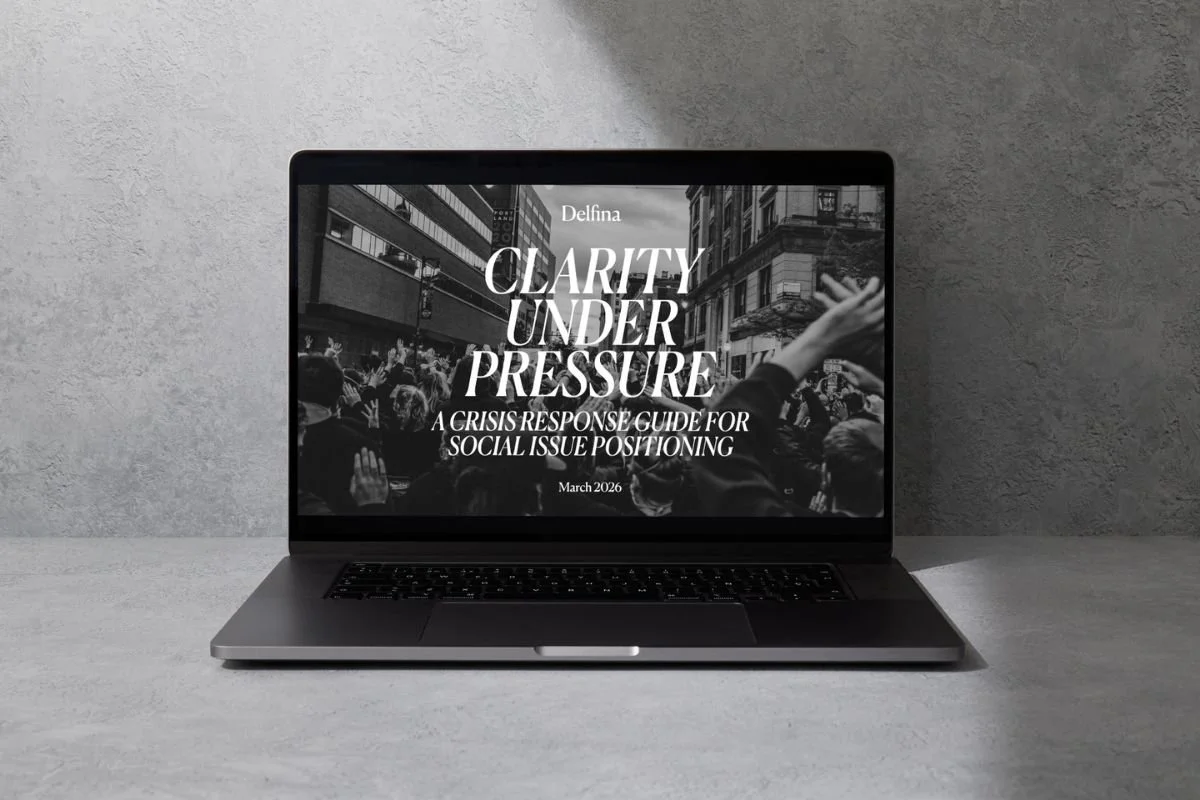
Why the standard crisis playbook doesn't work for social issues, and what to do instead
Something went wrong. The statement went out, and within hours it was being shared in contexts that had nothing to do with why it was written. One group read it as an endorsement they didn't ask for; another read it as an insult dressed up in corporate language. A third, probably the largest, read it as evidence that leadership had no idea what they were dealing with.
If this sequence feels familiar, it probably is. Social-issue crises have become one of the most reliably mishandled categories of corporate communications, not because organizations lack good communicators, but because the standard crisis toolkit was built for a different kind of problem.
The conventional crisis playbook assumes the central risk is saying the wrong thing. Get the statement right—empathetic, clear, appropriately timed—and the situation stabilises. That logic works reasonably well for product failures, executive misconduct, or operational disasters, where the underlying facts are contested but the interpretive frame is broadly shared. Everyone agrees that a data breach is bad; the question is how badly the company handled it.
Social-issue crises don't work this way: the interpretive frame is itself the contested territory. Whatever you say will be read through incompatible lenses simultaneously, and no version of the statement resolves that. The problem isn't the message; it's the structural conditions the message is entering.
The failure pattern, in sequence
What the research documents, across cases from Bud Light to Tractor Supply, from Disney's conflict with the Florida legislature to the wave of corporate retreats on DEI in 2024 and 2025, is a remarkably consistent failure sequence. It tends to run as follows.
A trigger event occurs: a piece of legislation, a cultural flashpoint, an employee campaign, a social media moment. The organization's communications team recognises it as something that requires a response, or at minimum a decision about whether to respond. This is already a different decision than it appears. The choice to stay silent is itself a communicative act, interpreted by different stakeholder groups as prudence, evasion, alignment, or complicity, depending on what they already believe about the organization.
The response, when it comes, is drafted to the problem as communications understands it: what language is safe, what commitments can be made, what tone signals the right values. What it almost never accounts for is that the organization's stakeholders are not a unified audience, but fragments of audiences: employees with divergent views, customers in different political and geographic contexts, investors with different time horizons, and activist groups on opposing sides. And all of them are watching the same statement and drawing conclusions that have little to do with what was written and everything to do with what each group expected. This is what researchers have called interpretative polarisation: not disagreement about the facts, but incompatible frameworks for what those facts mean.
The statement lands and the fragmentation becomes visible. The organization had been imagining a single audience. It discovers it has several, and they cannot be satisfied simultaneously. In the Bud Light case, the company's attempt at damage control after the Dylan Mulvaney partnership controversy neither protected the influencer from harassment nor placated the consumers who had organized a boycott. The silence and the subsequent tepid distancing satisfied no one, and what began as a targeted boycott became a sustained collapse, sales still roughly 40 percent below pre-controversy levels nearly two years later.
The next phase is the one that does the lasting damage. Facing pressure from multiple directions, the organization attempts to manage the noise rather than the substance. Statements are refined; spokespeople are deployed. The communications team works harder at the messaging layer while the underlying structural issue—the misalignment between what the organization publicly stands for and what its governance, operations, and culture actually reflect—goes unaddressed. This is the moment that converts a crisis into a credibility problem. Stakeholders across the spectrum, including those who were initially sympathetic, begin to infer that the organization is managing perception rather than exercising judgment.
The final stage is trust erosion that doesn't resolve cleanly. Tractor Supply's complete capitulation to conservative activist pressure in June 2024, eliminating DEI positions, withdrawing from Pride sponsorships, abandoning carbon reduction targets within weeks of a coordinated social media campaign, immediately triggered counter-backlash from the National Black Farmers Association and progressive consumer groups. The company had resolved one pressure by creating another, and in doing so signalled to everyone watching that its values were negotiable under sufficient pressure. That signal is difficult to walk back.
Why the playbook doesn't catch this
The standard crisis framework is built around a single assumption: that organizational credibility is essentially intact, and the task is to protect it from the communications fallout of a discrete event. Social-issue crises challenge that assumption from the first moment.
What the research consistently finds is that the crises which cause lasting reputational damage are not primarily communications failures, but governance failures—gaps between what an organization says it stands for and what its actual structures, policies, culture, and decision-making patterns reflect—that a crisis makes visible. When Bud Light's response to the backlash was incoherent, it wasn't because their communications team was incompetent; it was because the organization had no coherent position to communicate. The partnership with Dylan Mulvaney had not been grounded in sustained values-based positioning; it was a marketing decision that, when pressure came, had no structural support behind it.
This distinction matters because it changes what an effective response looks like, and when the work actually needs to happen. You cannot develop a governance-grounded position during a crisis. The organizations that navigate these situations with their credibility intact—Patagonia, Ben & Jerry's, Costco, each of which has faced sustained pressure during this period—are not distinguished by superior crisis communications, but by long-term consistency between stated values and operational reality, which gives them something to stand on when the moment comes.
What to ask before the crisis arrives
The governance-readiness questions that matter are not about communications at all. They are about the structural conditions that determine whether a credible response is even possible.
Does your organization's public positioning on social issues reflect commitments that are embedded in governance and operations, or are they primarily expressions of marketing intent? If the former, you have something to defend. If the latter, any defence will be undermined by the gap.
When a social issue relevant to your sector or stakeholder base becomes contested, who in your organization has decision authority over the response, and does that person have visibility into the operational reality, not just the communications implications? Crisis decisions made at the communications layer without governance authority tend to produce exactly the kind of ambiguous, partial responses that satisfy no one.
Have you mapped your stakeholder base with enough granularity to understand how a given issue is likely to be interpreted across different groups? Not to craft messages for each segment, but to understand the conditions you are entering before you commit to a position.
Does your organization have a history of consistency on this type of issue, or would any position you take now be the first? Stakeholders, including journalists, activist organizations, and institutional investors, assess credibility in part by consistency over time. A first statement on a contested issue, absent a track record, reads differently than a consistent one.
And finally: Is your organization prepared for the possibility that there is no response that satisfies all stakeholder groups simultaneously, and that attempting to find one may be more damaging than accepting that trade-off explicitly?
These are not communications questions. They are organizational ones, and they require answers before a trigger event forces the issue.
If the failure pattern described here is familiar, the harder question is what to build instead. Clarity Under Pressure is a governance-first framework for organizations navigating social-issue crises. Not a messaging guide, but a structured approach to the decisions that determine whether a credible response is even possible.