Five signs your organisation can handle a social-issue crisis (and what's missing if it can't)
In June 2024, Tractor Supply Company cut DEI roles, pulled back from Pride sponsorships, and ditched carbon-reduction targets within weeks of a coordinated social-media campaign by conservative activists.
The reversal was immediately met with backlash from the National Black Farmers Association and progressive consumer groups.
Three weeks earlier, CEO Hal Lawton told the Associated Press the company would stay consistent on DEI and ESG. Then the company posted a single sentence to X: "We have heard from customers that we have disappointed them. We have taken this feedback to heart." They never explained why they changed course. That silence, and how fast they reversed commitments, signalled to every stakeholder group that the company's values depended on who was shouting loudest.
Treating the episode as a communications problem instead of a governance problem made things worse, and it's a very common corporate misstep.
Why governance, not messaging
Recent research shows a clear pattern: organisations that keep credibility have already done the structural work that gives them something real to say when pressure hits. They don't just rely on slick messaging.
Organisations without those governance basics get exposed fast. Take Bud Light: when its response to the Dylan Mulvaney partnership drifted into silence and weak distancing, it wasn't just a communications fail. The partnership wasn't grounded in a sustained values-based position, so there was nothing coherent to defend.
This difference changes how you prepare. You can't build governance in the middle of a crisis, but you can check, ahead of time, whether the structural conditions for a credible response are in place. The five indicators below will help you do that.
The five indicators
1. Clear decision ownership
Who in your organisation can actually commit to a position when a sector-relevant social issue gets contested? Not just draft a statement, but accept the tradeoffs that come with it. If the answer is "we need a meeting," you don't have clear ownership.
Under pressure, fuzzy authority nets hedged, noncommittal messaging. That's a governance gap: the organisation never actually made a decision worth defending.
2. Explicit tradeoff acknowledgment
Any stance will alienate some stakeholders. Organisations that are governance-ready call out those tradeoffs ahead of time. They know who will object and accept that disagreement is the cost of clarity. Organisations that aren't ready spend a crisis trying to find wording that offends no one; the result pleases nobody and signals they're managing perception, not exercising judgment. That's how a reputational issue becomes a credibility problem.
3. Operational embedding
Values have to be operational, not just rhetorical. Beyond a purpose statement or a paragraph in an ESG report, you should be able to point to concrete things: a budget line, a staff role, a governance mechanism that shows the commitment exists in practice. When Patagonia gets scrutinised, it can point to structures, supply-chain choices, and decades of activism tied to revenue — a history that makes its language credible. Without those operations, claims ring hollow and others will spot the gap fast.
4. Narrative continuity
Six months in, your stance should still line up with your opening position. Wording can shift as facts change, but the same values, tradeoffs and decision logic should be visible. The updates should reconstruct a single, coherent story.
Credibility crumbles when each update reads like a separate draft. Stakeholders, journalists, and activists notice. Narrative discontinuity doesn't look like adaptation. It looks like there was no underlying position to begin with, and that perception usually kills credibility.
5. Friction tolerance
Disagreement is the cost of taking a position, not a comms problem to be solved. Any clear stance will inevitably alienate some people.
Trying to please everyone is a governance failure: it shows a lack of decision-making and signals that commitments are negotiable. That signal is far harder to manage than simply standing by an initial position, even a controversial one.
What to do with a no
If this diagnostic finds gaps — and most organisations will — the fix is structural, not editorial, and it needs to happen before a trigger, not during one.
Write down decision authority: who can decide and what they can commit to.
Call out tradeoffs early: ask "Who will disagree, and are we prepared to absorb that?"
Embed values operationally: point to the budget line, staff role, or governance mechanism that shows the commitment exists.
Keep narrative continuity by recording the decision logic, not just the outcome, so that month six still aligns with month one without relying on memory.
Adopt friction tolerance: formally accept that some stakeholders will disagree. Disagreement is the cost of clarity, not proof the position is wrong.
Do this work beforehand and your organisation will have something real to stand on when pressure arrives.
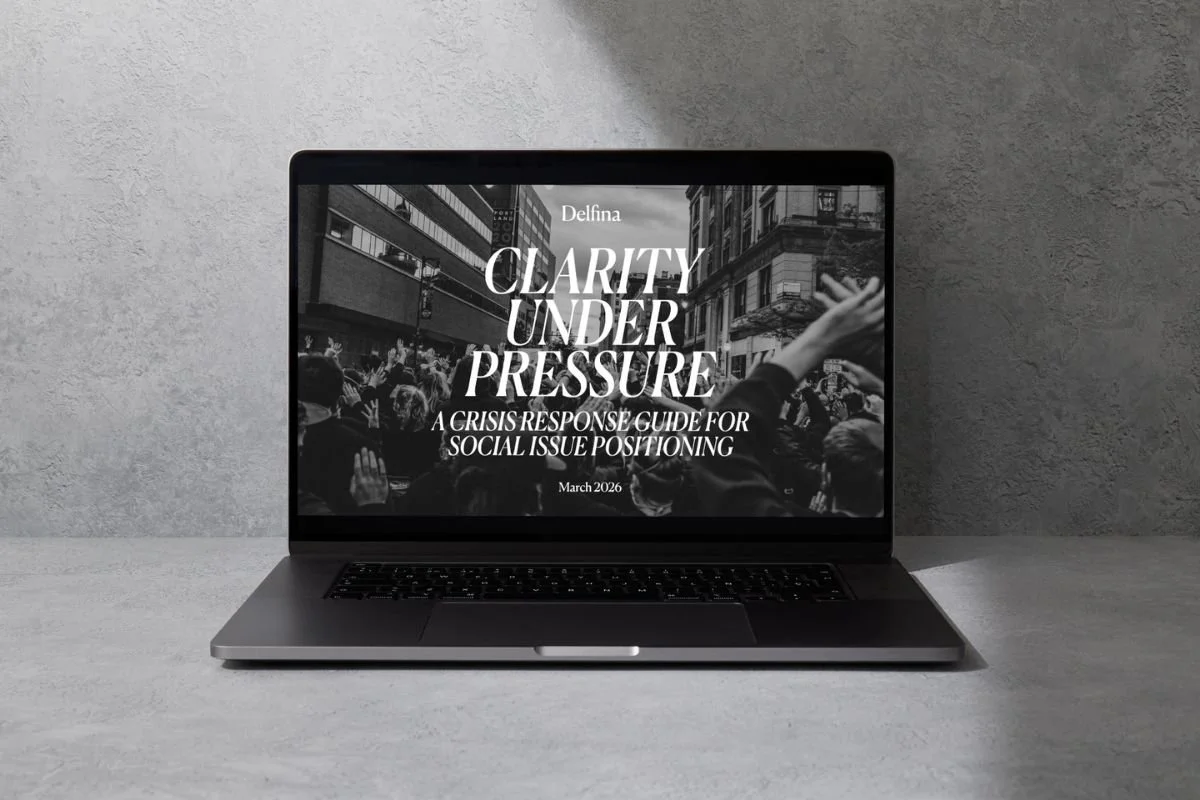
Clarity Under Pressure lays out the full governance-readiness framework: the five indicators, the decision structures that back them, and a step-by-step response protocol. Download it free here.